站点介绍
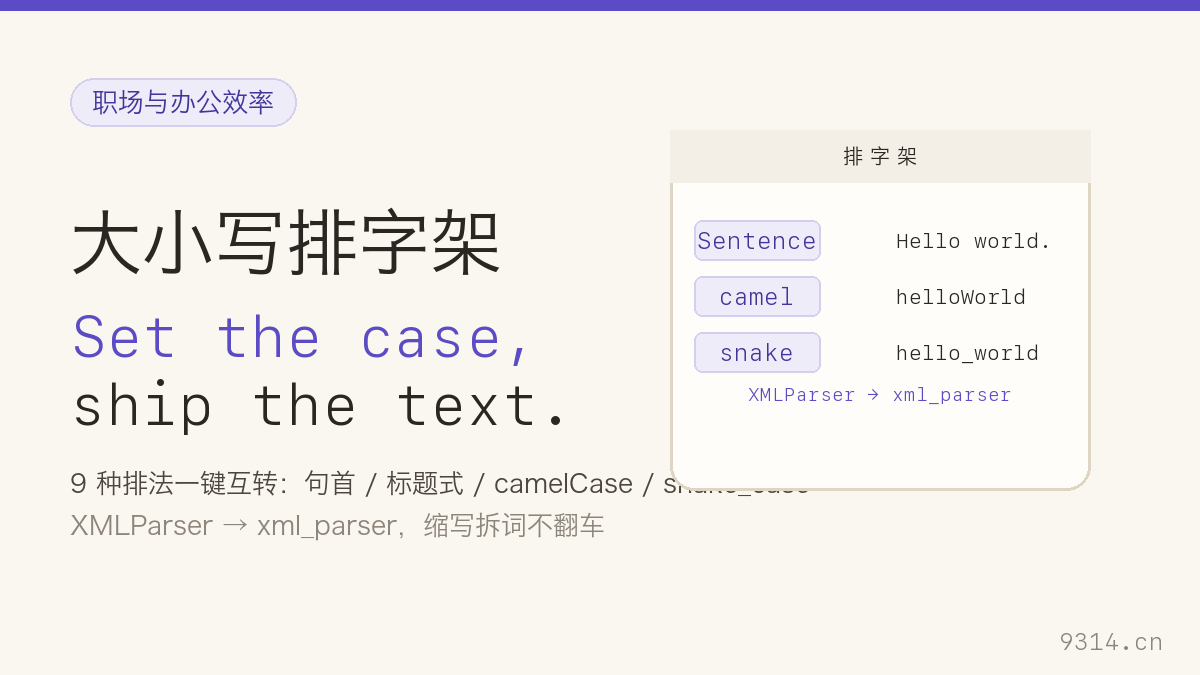
Two case failures I keep running into, years apart. First: a release email with the subject typed in ALL CAPS, which every mail client treats as shouting - open rates droop, and the fix is sentence case, not a rewrite. Second: a refactor that renamed forty snake_case columns to camelCase, where one missed letter means a property that silently reads as undefined and fails three screens away from the cause. Both problems are one paste away from being solved here.
What makes a converter hard is not uppercasing - that is one method call. It is splitting words back out once case and separators have done their job. XMLHttpRequest is three words to a human and a wall of letters to a naive splitter. Runners of capitals are the trap: XML, HTTP, JSON are single words, so the parser has to know that the capital starting "Parser" belongs to the next word, not the acronym. Get it wrong and you ship x_m_l_http_request.
This tool's tokenizer treats a run of capitals as one acronym and hands the final capital to the next word when lowercase letters follow it. So XMLParser lands as xml_parser, getJSON as get_json, parseJSONData as parse_json_data. It also accepts mixed input - snake, kebab, spaces and camel all at once - because real-world identifiers are never one convention.
Sentence case capitalizes only after a sentence ends - period, question mark, exclamation, or a newline - which is the register people actually read email and documentation in. lowercase and UPPERCASE are the workhorses: normalizing data before a comparison, or feeding the punchline of a headline. Title Case capitalizes content words and lowercases the small ones - a, an, the, of, and, or, but, in, on, at, to, for, and friends - while keeping the first word capitalized, which is what most style guides ask for. (Chicago and AP disagree at the margins; no converter settles that argument.)
camelCase for JavaScript variables and function names; PascalCase for classes, types and components; snake_case for Python and SQL column names; kebab-case for CSS classes, HTML attributes and URL slugs; CONSTANT_CASE for environment variables and true constants. The differences sound pedantic until a lint rule rejects your pull request over one of them, or a teammate greps for user_data and finds nothing because the codebase says userData.
Software cannot read minds about proper nouns. Sentence case folds NASA to nasa and Title Case lifts iphone to Iphone, because the machine has no dictionary of names worth trusting at this scale - the honest move is to let you touch those up by hand. Chinese, Japanese and Korean text carries no case at all, so it passes through untouched (this tool is built for English text). And the input cap is 1MB, about half a million English words, set so a pasted novel cannot freeze the tab.
The tokenizer treats runs of uppercase letters as one acronym: XML is one word, Parser is another, so you get xml_parser. Likewise getJSON splits into get and JSON. This is exactly where most case converters fail, so this tool carries dedicated acronym-splitting logic.
No. Chinese characters have no case, so the conversions only touch the 26 Latin letters - hanzi, CJK punctuation and emoji pass through untouched. Note the tool is built for English text; pasting pure Chinese simply returns it unchanged.
No. Sentence case capitalizes only the first letter of each sentence and lowercases the rest, the way people normally write. Be aware that an acronym like NASA gets lowercased to nasa, because software cannot tell which words are proper names - use Title Case or touch it up manually when acronyms must stay uppercase.
Only the first word: camelCase keeps the first word lowercase and capitalizes the rest, like userName; PascalCase capitalizes every word, like UserName. JavaScript variables favor camelCase, while Java and C# class names favor PascalCase. The tool converts to both in one click.
It is rejected with a clear message. 1MB is roughly half a million English words, so normal use never hits the cap - the limit exists to stop a pasted novel from freezing the tab. Split very long text into a few passes.
No. Converting, counting, copying and downloading all happen inside this device's browser - zero network requests, and the text itself is never written to local storage. Only your last-used mode is kept in this browser so the page opens the way you left it; the Clear my data link in the footer removes it.
中文版:https://www.9314.cn/tools/case-converter/
相似站点
评论列表 (0条)

 "Case Converter: 9 Case Formats, One Click Each")
 "英文大小写转换:9 种格式一键互转,代码命名不翻车")